
Bespoke route · Tajikistan
Pamir Highway Adventure — 9 days / 8 nights
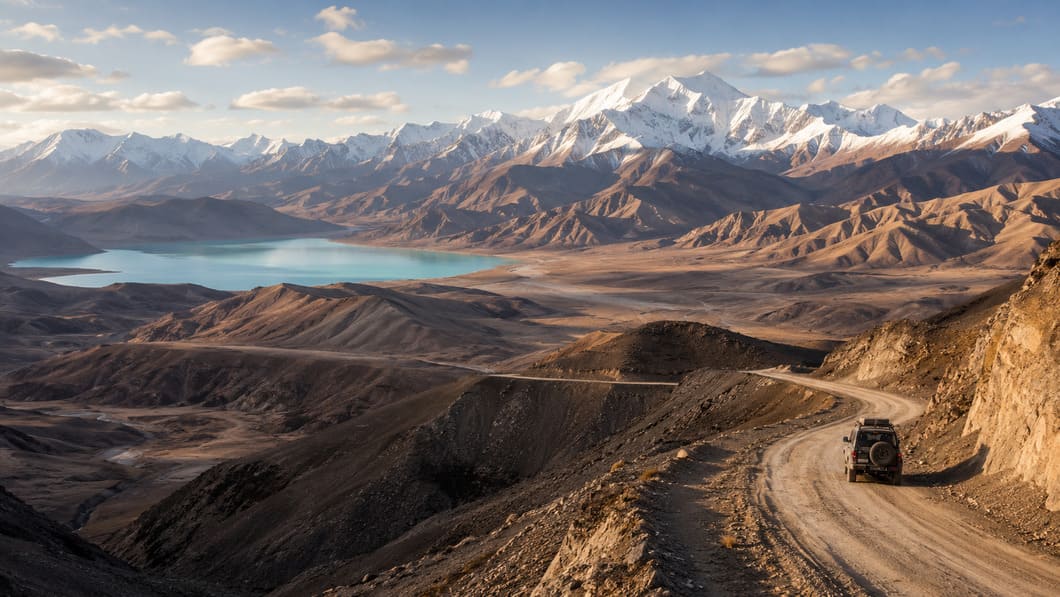
An expedition along the Pamir Highway through the Wakhan Valley, Murghab, Karakul and Bartang — to some of the most remote and spectacular places in Tajikistan.
ABOUT THE ROUTE
The Pamir Highway: a grand journey across the Pamirs
What you will see and feel on this journey is like stepping into another century — a time when people lived in an entirely different way.
This route promises to become a true adventure of a lifetime. Remote corners far from civilisation, an unusual way of life, a meeting of different cultures and ancient history — this is what a journey across the Pamirs is about.
One branch of the Great Silk Road ran through this region — the route across the Pamir Mountains. The Pamirs are one of the highest mountain systems on the planet, reaching up to 4,900 metres above sea level. From here you can also see the famous Hindu Kush mountains in Afghanistan.
Tour price
1 person — 2,230 USD
2 people — 1,115 USD per person
3 people — 744 USD per person
4 people — 558 USD per person
TRIP PROGRAMME
Day-by-day itinerary
Today we set off for the village of Kalaikhum via the city of Kulob. Along the way you will see the Nurek Reservoir.
The highest point of the day is the Shurobod Pass at 2,267 m, after which the road runs along the border with Afghanistan.
This stretch of the route will amaze you with its unique mountain landscapes — this is the land of the Pamirs. For centuries the Pamirs inspired the world's greatest explorers, among them Marco Polo, Xuanzang and Mirza Muhammad Haidar.
Now you have the chance to be here too. The road follows a natural border — the Panj River. Many travellers who have visited the Pamirs have called this vast mountain system “an ocean of blue and white mountains”.
In the morning we continue along the border, enjoying views of Afghanistan.
The drive to Khorog takes about 5–6 hours. Khorog is one of the smallest cities on the world map. It is surrounded on all four sides by rocky mountains.
The city lies at the confluence of three rivers: the Shokhdara and the Gunt flow into the Panj here.
Among the Pamiri people you will fairly often meet those with fair hair, light skin and blue eyes. The Pamirs are considered one of the highest inhabited mountain regions in the world after the Himalayas in Tibet.
Life in the mountains has shaped the distinctive traditions of the local people.
We continue our adventure towards the Wakhan Valley.
In the 19th century the Wakhan served as a buffer zone between the Russian and British empires.
Set in the very heart of Asia, the Pamirs are a land of majestic snow-capped mountains, clear blue lakes and rivers, broad valleys and dry deserts. For hundreds of years these mountains have been called the “Roof of the World”. Today you will understand why.
Along the way we stop at the Kakh-Kakha Fortress, dating back to the 3rd century. It offers an impressive view over the Afghan part of the Wakhan Valley.
Next we climb up to the Yamchun Fortress, with the Bibi Fatima hot spring on the slope below.
In the village of Yamg we visit the restored house of the Sufi mystic Muborak Kadam, who died in 1910. Beside the house stands a stone pillar with an opening that he used to calculate the solar calendar.
Another stop is the village of Vrang, home to a Buddhist complex from the 4th–7th centuries.
In the morning we continue through the Khargush Valley.
On the way we cross the Khargush Pass at 4,344 m.
Two of the most beautiful lakes in the Pamirs — Yashilkul and Bulunkul — lie in the Murghab district at about 3,700 m above sea level.
In sunlight the water of Bulunkul shimmers in shades of violet and blue. The lake is home to several species of fish.
Here you can also see yaks — remarkable domestic animals traditionally used as pack animals and also kept for milk and meat.
On arrival at the lake there is a walk of about 1–2 hours.
We then head on to Murghab along the legendary Pamir Highway.
Right beside the Pamir Highway lies the pale-blue Lake Karakul at 3,815 m. Its name translates as “Black Lake”.
On the way to the lake we cross the highest pass, Ak-Baital, at 4,655 m.
Karakul is considered one of the highest large lakes in the world, apart from the lakes of Tibet and Lake Titicaca.
The lake sits in a meteorite crater and is surrounded by wet meadows and marshes with rich flora and fauna, including some endemic species.
The landscape is shaped by floods, thawing permafrost and buried ice masses. Small hills, streams and watercourses are found here at altitudes between 3,500 and 4,000 m.
The abundant vegetation provides pasture for wild and domestic hoofed animals.
A short walk around the lake is included, after which we return to Murghab for the night.
In the morning we set off for Khorog along the Pamir Highway, also known as the M41.
It is considered the second-highest mountain road after the roads of Tibet. The route runs through mountains and passes at over 4,000 m above sea level.
Along the way we cross the Koitezek Pass at 4,271 m.
The rugged terrain and rocky mountains of this region have become a refuge for a unique variety of wildlife.
The Pamirs are home to a significant population of the Marco Polo argali — one of the largest wild sheep in the world — as well as the rare and endangered snow leopard.
Today we head into the Bartang Valley.
Bartang is one of the wildest and most memorable valleys of the Western Pamirs. Even the Pamiri people themselves consider it one of the most distinctive regions of their homeland.
We drive as far as the turn-off towards the Jizev Valley, from where a hike of about 2–3 hours leads up to the village.
Tonight you will stay in a genuine traditional Pamiri house and get to know the mountain way of life of the local people.
Overnight and dinner with a local family.
In the morning we walk back down to the main road, where the driver meets you and takes you to Kalaikhum.
The road from Rushan to Kalaikhum follows the same route.
This area is surrounded by high rocky mountains of over 6,000 m, and only one road could be built here.
Travelling across the Pamirs gives visitors a rare chance not only to admire the beauty of untouched nature, but also to learn more about the ethnography, history and life of the mountain peoples.
Along the way we stop in small villages where you can talk to local people and see their everyday life.
The settlements lie on both sides of the river in narrow mountain valleys. On the opposite bank you can see Afghan villages and gardens among the cliffs.
In the morning we set off for Dushanbe along the mountain road.
We cross the high Khaburobot Pass at 3,252 m, known as part of the Western Pamir Highway.
The road runs through scenic river valleys and impressive gorges, with stops to rest and photograph the mountains and rivers.
Along the way there are small villages and encounters with local people.
Tajiks are by nature hard-working, hospitable and warm-hearted. They cherish their traditions and folklore.
This tour is especially rewarding for lovers of the exotic, for those interested in ethnic and cultural diversity, and for anyone who values the beauty of wild nature.
Dinner at a restaurant. Overnight at the hotel.
End of the tour.
The order and content of days may be adjusted to departure dates and weather.
CONDITIONS
What’s included
- Transport — 4×4 off-road vehicle
- All breakfasts
- All dinners
- Accommodation: Kalaikhum, Khorog, Langar, Murghab, Jizev — homestay / guesthouse; Dushanbe — Asia Grand Hotel 3★
- Entrance tickets to all museums
- Mineral water throughout the tour
- National park entrance fee
What’s not included
- International flights
TRAVELLER REVIEWS
How it went
AL
★★★★★
Anna Levchenko, Moscow
The best trip of our lives. The Sayohat team thought of every detail — from the airport pickup in Dushanbe to sunsets over the Pamirs. We simply enjoyed ourselves while everything else was taken care of for us.
DS
★★★★★
Dmitry Sokolov, Saint Petersburg
The Pamir Highway is another planet. Our guide Farrukh knew every pass and every legend. The vehicles were reliable and the guesthouse stays were heartfelt.
EM
★★★★★
Ekaterina Morozova, Kazan
Samarkand exceeded all expectations. The Registan at dawn gave us goosebumps. Transfers, hotels and the guide worked flawlessly, without a single hitch.
SEE ALSO
Similar routes
GET A TOUR QUOTE
Let’s price your tour: Pamir Highway Adventure
Leave your contacts — we’ll pick dates, hotels and send the exact price with a programme.
from 92,185 ₽