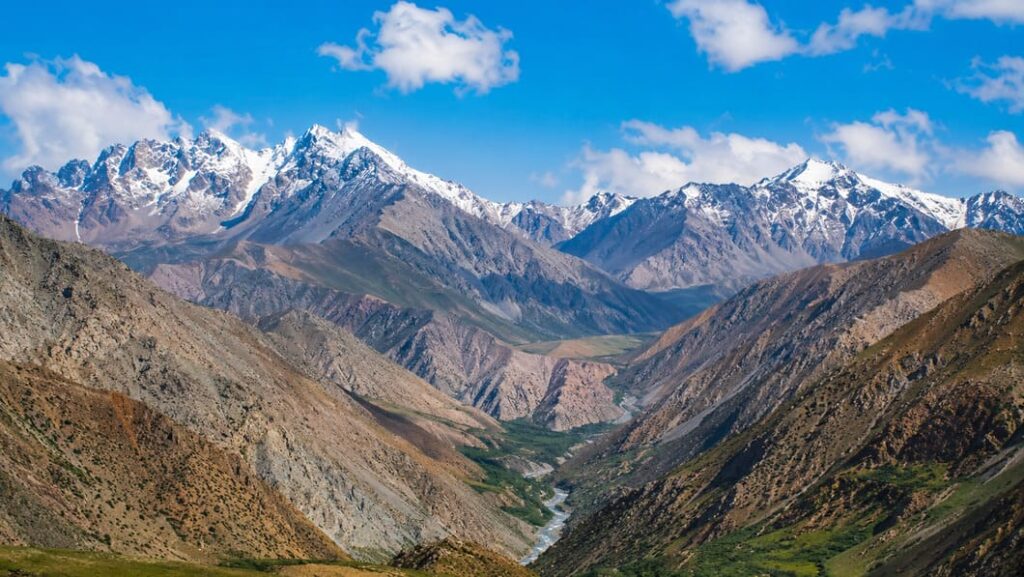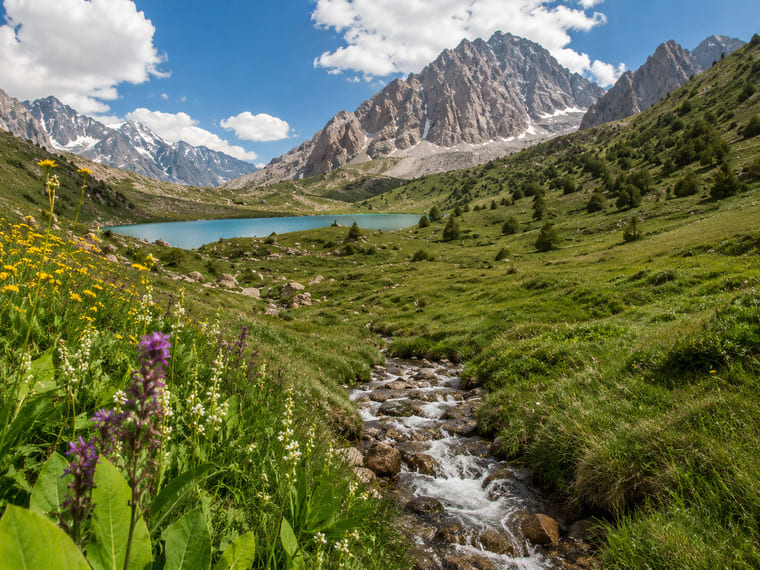
The Fann Mountains are one of the main areas for mountain travel in Tajikistan. Within a relatively compact territory they bring together turquoise lakes, rock massifs, passes and peaks above 5,000 metres. A single route can combine Iskanderkul, the Kulikalon and Alaudin lakes, Artuch, high-altitude valleys and multi-day trekking.
The format of the trip depends on your fitness and the number of free days. Iskanderkul suits a one-day road excursion, the Artuch area suits short mountain routes, while crossings over the Alaudin pass and Chimtarga require several days and good physical condition.
Where the Fann Mountains are
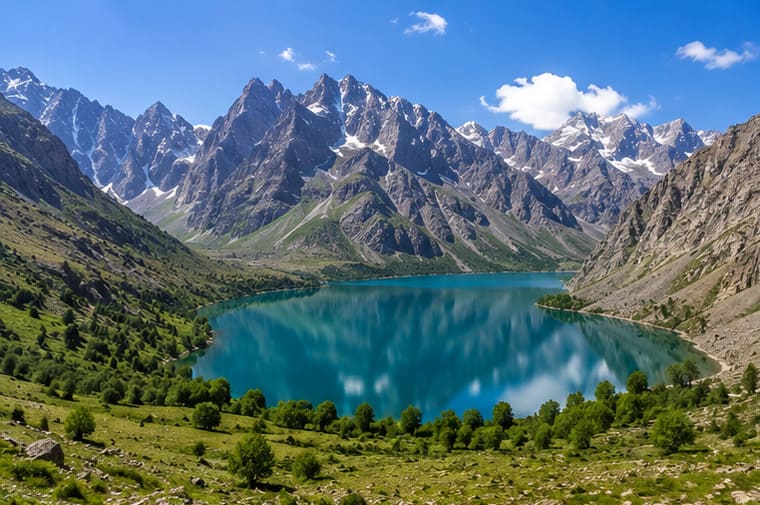
The Fann Mountains lie in the western part of Tajikistan and belong to the Pamir-Alay mountain system. For travellers, the main gateways to the area are Dushanbe and Penjikent.
The defining feature of the Fanns is the concentration of natural sites. There are dozens of mountain lakes here and a whole group of well-known five-thousanders. The most popular areas include Iskanderkul, Artuch, the Kulikalon basin, the Alaudin lakes, Bolshoe Allo lake and the Chimtarga area. Tajikistan’s official tourism portal lists more than 30 lakes and several peaks above 5,000 metres within the Fann Mountains.
For a first trip it is convenient to choose a single area. A longer holiday makes it possible to link several valleys into a full trekking route.
The destination in brief:
- Country: Tajikistan
- Format: road excursions, walking routes, trekking
- Main season: June — September
- Key places: Iskanderkul, Artuch, the Kulikalon lakes, the Alaudin lakes, Chimtarga
- Length of trip: from 1 day to 7–10 days and more
What makes the Fann Mountains worth visiting
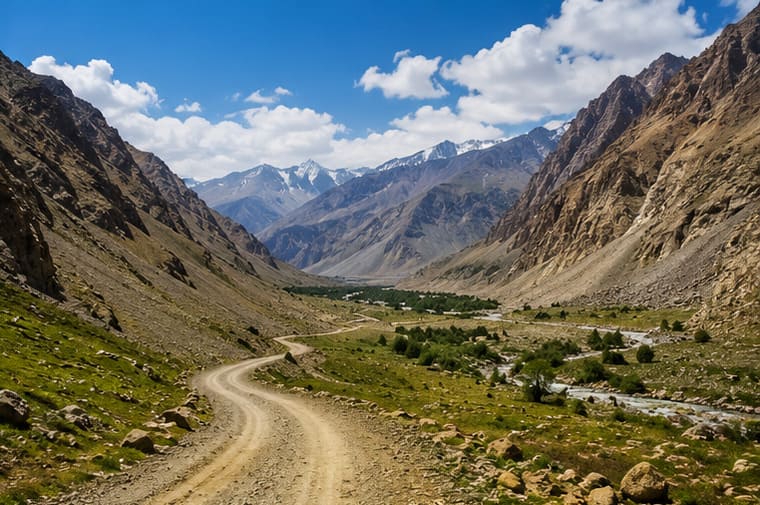
The main reason to come here is the variety of routes within a small area. Over a few days the landscape changes from inhabited valleys and juniper slopes to stony passes and high-altitude lakes.
High-altitude lakes
The lakes are one of the defining features of the Fann Mountains. Depending on depth, light and the composition of the rock, the water takes on blue, turquoise and deep indigo shades.
The best-known areas are associated with Iskanderkul and the Kulikalon and Alaudin lakes. On multi-day routes, Mutnoe lake, Bolshoe Allo and small bodies of water between the passes are added to these.
Routes of varying difficulty
You do not have to plan a week-long hike straight away to get to know the region. Iskanderkul is accessible as a road excursion. Walking routes to the Kulikalon lakes start from Artuch. Well-prepared travellers continue over the passes to the Alaudin lakes and Chimtarga.
High peaks
The relief of the Fann Mountains is shaped by massive rock formations. Among the best-known peaks are Chimtarga, Energia, Chapdara and Bolshaya Ganza. Chimtarga reaches 5,489 metres and is considered one of the key summits of the area.
A convenient blend of nature and history
A mountain route can be linked with Dushanbe and Penjikent. On a longer trip, the region combines well with a cultural programme through other parts of Tajikistan.
What to see in the Fann Mountains
Iskanderkul lake
Iskanderkul is one of the best-known lakes in Tajikistan and a convenient starting point for a first acquaintance with the Fann Mountains.
The route here suits travellers who want to see a mountain area without a multi-day hike. Around the lake you can walk along the shore, visit the waterfall often called the “Fann Niagara”, and spend time in the Sarytag valley. These places are also part of the region’s official tourist routes.
A trip to Iskanderkul fits easily into longer Tajikistan tours.
The Alaudin lakes
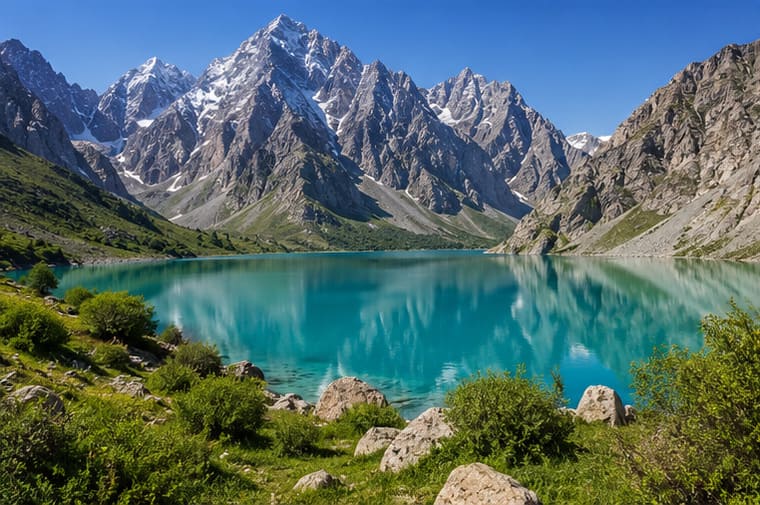
The Alaudin lakes lie in the central part of the popular trekking routes of the Fann Mountains. They are valued for their clear, deep blue water and their closeness to high rocky summits.
People usually arrive here on foot. One of the classic options links the Kulikalon and Alaudin lakes over the Alaudin pass. The region’s official routes allow for crossings of around six to seven hours a day, so this format already calls for preparation and suitable equipment.
The Kulikalon lakes
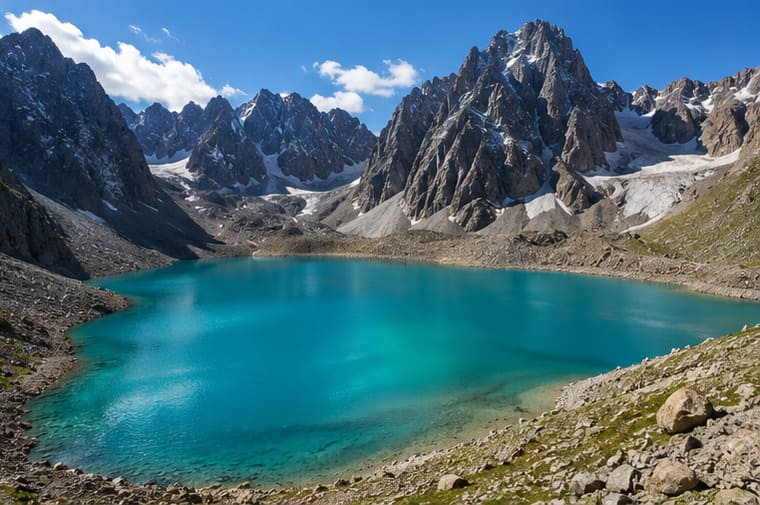
The Kulikalon basin is one of the key areas of the Fann Mountains for walking. It holds a group of lakes among rock walls, scree and high-altitude vegetation.
According to Tajikistan’s tourism portal, there are around 14 lakes in the Kulikalon area. The classic route from Artuch takes roughly five hours of active walking and brings you out at altitudes of about 2,800–2,900 metres.
Kulikalon works both as a destination in its own right for a few days and as part of a longer route to the Alaudin lakes.
Artuch
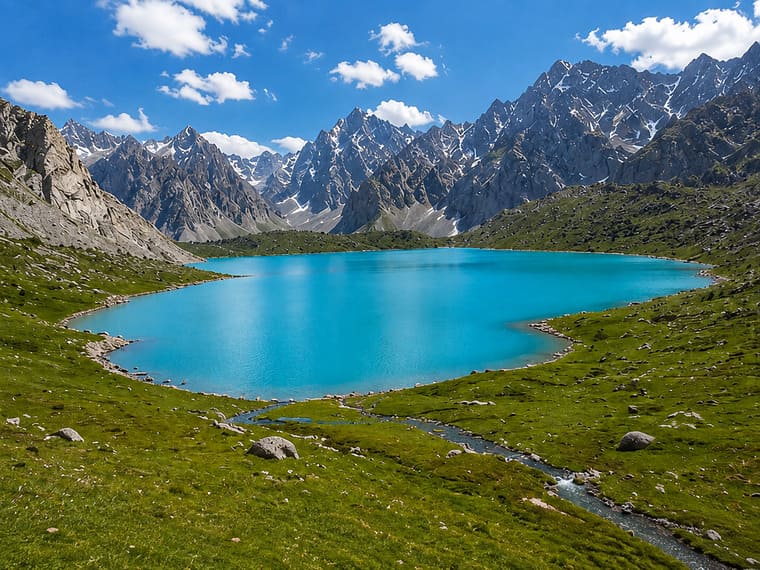
Artuch is one of the main starting points for trekking in the Fann Mountains.
Routes to the Kulikalon lakes pass through this area, and on to the Alaudin lakes and higher passes. For that reason Artuch is often used as the place to begin the active part of a multi-day journey.
For the traveller it is a convenient transition between the road section of a route and a proper hike.
The Seven Lakes
The Seven Lakes in the Penjikent area suit travellers interested in mountain scenery combined with a road route and short walks.
The lakes lie in a cascade at different altitudes. The trip can be linked with Penjikent and then continued into other parts of the Fann Mountains.
This route works well for the first days of a trip: it gives a sense of the region’s landscapes without having to head straight for the high passes.
Chimtarga
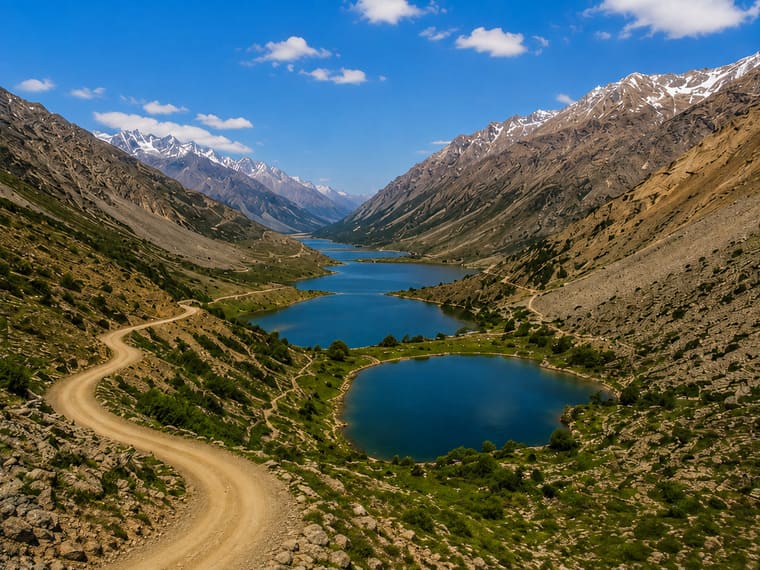
Chimtarga is the highest point of the Fann Mountains and one of the main landmarks for experienced travellers.
In trekking programmes, however, it is more often the Chimtarga pass, at around 4,740 metres, that features. The route to it runs past the Alaudin and Mutnoe lakes, then continues towards Bolshoe Allo lake.
This crossing is intended for well-prepared travellers. The altitude, the long stages and the self-supported sections call for good physical condition and carefully planned acclimatisation.
Which Fann Mountains route to choose
The length of a trip is best decided by physical fitness and the kind of holiday you want.
| Route | How much time to allow | Format |
|---|---|---|
| Iskanderkul | 1 day | car + walks |
| The Seven Lakes | 1–2 days | car + short walks |
| Artuch — Kulikalon | 2–3 days | trekking |
| Kulikalon — the Alaudin lakes | 3–5 days | multi-day trekking |
| Route over Chimtarga | 7 days and more | demanding high-altitude trekking |
A one-day trip to Iskanderkul suits a first acquaintance with the region.
If the main aim is a walking route, it is worth allowing at least three or four days. That makes it possible to see several lakes without building the programme purely around transfers.
A long route over Chimtarga calls for a full holiday. Official programmes in the central part of the Fann Mountains take around 10–12 days including arrival, transfers and the active section.
When is the best time to visit the Fann Mountains
The main season runs from June to September. This period is used for most trekking programmes in the region.
June
The active tourist season is already under way in the valleys. On the high passes, conditions depend on how much snow fell in winter and on the weather of the particular year.
June suits Iskanderkul, the lower valleys and some of the walking routes.
July and August
This is the main period for multi-day trekking.
The high-altitude sections become more accessible, and the long daylight hours make it easier to plan the stages.
During the day it can be hot in the sun even high in the mountains, while in the evening and at night the temperature drops considerably.
September
September suits those who prefer cooler weather.
The air becomes clearer, there are usually fewer walkers on the routes, and high-altitude crossings are still in season when the weather is settled.
When planning for the second half of the month, it is worth paying closer attention to the forecast and the altitude of the route.
How to get to the Fann Mountains
There is no single entry point to the Fann Mountains. The journey depends on the route you choose.
From Dushanbe
Dushanbe is a convenient place to begin a trip to Iskanderkul, and for routes that continue on to Artuch.
In official tourist programmes, the transfer from Dushanbe to Artuch takes about four to five hours. The walking part of the route to the Kulikalon lakes begins from there.
For trips into the mountains it is best to arrange transport in advance: the condition of certain stretches of road depends on the season and the weather.
From Penjikent
Penjikent is convenient for visiting the Seven Lakes and the western part of the region.
The town can be used as a staging point between a cultural programme and an active holiday in the mountains.
As part of a longer route through Tajikistan
If the Fann Mountains form part of a longer trip, it is convenient to link the mountain sections with Dushanbe, Penjikent and other regions of the country in advance.
You can see the available routes through Tajikistan in the general tours section.
Trekking in the Fann Mountains
Trekking here varies widely in difficulty.
The short route from Artuch to the Kulikalon lakes takes a few hours and suits travellers with basic physical fitness.
The crossing between the Kulikalon and Alaudin lakes already involves a pass and a long day on foot.
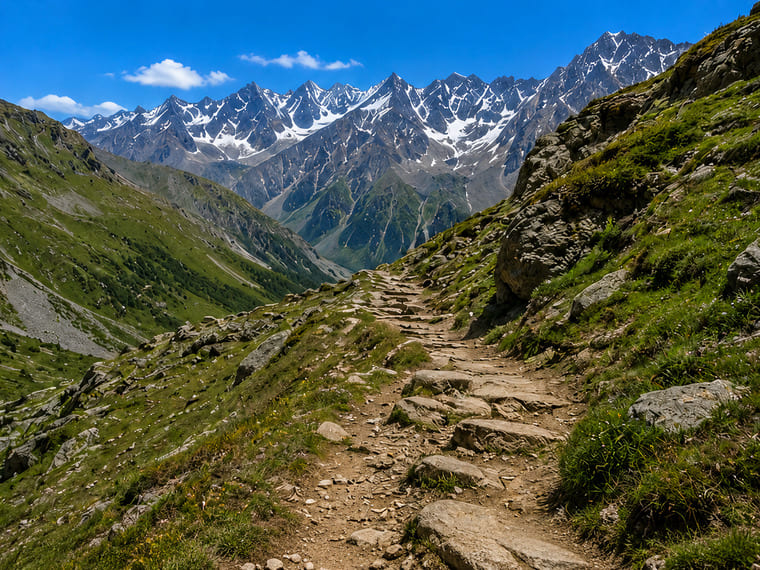
Routes past Mutnoe lake and over the Chimtarga pass run at altitudes above 4,000 metres. The Chimtarga pass reaches roughly 4,740 metres.
For programmes of this kind, what matters is:
- a gradual gain in altitude;
- days with a sensible workload;
- spare time for changes in the weather;
- suitable footwear;
- protection from sun and wind;
- an adequate water supply;
- a well-thought-out plan for overnight stops.
At high altitude the pace of movement is usually slower, so familiar distances take longer.
Where to stay in the Fann Mountains
The kind of accommodation depends on the area.
Guesthouses
Guesthouses suit inhabited valleys and road routes. This option is convenient near Iskanderkul and in the villages along the way.
Conditions are usually simple: a room, basic facilities and home cooking.
Trekking bases
Artuch and some other popular starting points make it possible to arrange a night’s stay before setting out on a route.
This is convenient if the active part begins in the morning.
Tents
On long treks, a tent remains the main form of accommodation.
Official routes around the Kulikalon and Alaudin lakes use tent camps at altitudes of about 2,800–3,500 metres and higher.
For a journey of this kind, camp sites and the amount of equipment need to be settled in advance.
What to take with you
The kit depends on the altitude and the length of the route, but most trips will call for:
- comfortable trekking boots;
- light clothing for the day’s walking;
- a warm layer for the evening;
- a windproof and waterproof jacket;
- a hat;
- sunglasses;
- SPF cream;
- a personal first-aid kit;
- a bottle or hydration pack;
- a power bank;
- a small rucksack;
- trekking poles for the longer stages.
For a tent-based route, add a sleeping bag rated for the right temperature, a mat and other camping equipment.
It is best to pack in layers: within a single day the temperature in the valley, on the pass and in camp in the evening can differ markedly.
Communications, money and practicalities
Outside the settlements, mobile coverage is unreliable. On some sections of multi-day routes it may be absent altogether.
Before heading into the mountains it is worth:
- downloading offline maps;
- telling family and friends about the programme;
- carrying a power bank;
- saving the contacts of your host organisation;
- taking a supply of cash.
In small settlements, paying in cash is more practical than using a bank card.
On a hike, it is convenient to keep documents, electronics and some clothing in sealed bags or waterproof covers.
Do you need a guide in the Fann Mountains
For a road trip to the well-known sights, the escort’s main job is logistics and organising the programme.
On a multi-day trek the guide’s role is broader. They help set the pace, navigate at junctions, judge the state of a pass and organise places to camp.
An escort matters especially on routes:
- crossing several passes;
- at altitudes above 4,000 metres;
- with self-supported overnight stops;
- involving moving camp;
- far from settlements.
On a first multi-day hike in the region, an organised route makes the logistics considerably simpler.
How many days you need for the Fann Mountains
There is no single optimal length for the Fann Mountains.
1 day — a trip to Iskanderkul.
2–3 days — one area, for example Artuch and the Kulikalon lakes.
4–5 days — several lakes and passes without covering the whole massif.
7–10 days — a full route taking in several valleys and high-altitude crossings.
10–12 days and more — a demanding trek over the Chimtarga pass with additional side trips.
For a first trip it makes sense to concentrate on two or three key areas rather than trying to cover the whole massif.
The Fann Mountains and the Pamirs: two different formats of travel
Both are among the main mountain regions of Tajikistan, but the experience and the logistics differ.
| The Fann Mountains | The Pamirs |
|---|---|
| a more compact area | long distances between points |
| a high concentration of lakes | vast valleys and high-altitude plateaus |
| a well-developed multi-day trekking format | a strong road and expedition format |
| routes are conveniently built over several passes | a significant part of the trip runs along the Pamir Highway |
| easy to combine with Penjikent | Khorog is the central point of many routes |
For a traveller who wants to walk a great deal and see a variety of lakes over several days, the Fann Mountains offer particularly convenient geography.
The Pamirs are more often chosen for their scale, long transfers and high-altitude roads.
An example 7-day route through the Fann Mountains
The programme depends on the season and level of fitness, but the general shape of the journey might look like this.
Day 1. Dushanbe — Iskanderkul
Transfer from the capital into the mountains. A walk by the lake, a visit to the waterfall and an overnight stay in the Iskanderkul area.
Day 2. Iskanderkul — Artuch
A morning by the lake, then on to the starting point of the walking section.
Day 3. Artuch — the Kulikalon lakes
The first full day on foot. A gain in altitude and arrival at the Kulikalon basin.
Day 4. Kulikalon — the Alaudin lakes
A crossing over a mountain pass and a descent to the Alaudin lake system.
Day 5. The Alaudin lakes
A side walk around the surrounding area, a rest and the chance to head towards Mutnoe lake.
Day 6. Return from the mountain area
A descent to the transport point and the end of the active section.
Day 7. Return to Dushanbe
Transfer to the capital.
This is an outline to convey the logic of the route. The actual stages, camp sites and number of days are settled with the state of the roads, the weather, the altitude and the group’s fitness in mind.
Planning the trip
The Fann Mountains make it possible to put together a programme for almost any format: from a single day at Iskanderkul to full trekking past the Kulikalon and Alaudin lakes.
For a first trip it is worth settling three things: the number of days, the physical effort you are prepared for and the kind of overnight stays you want. After that the route comes together far more easily.
Sayohat Travel arranges trips through Tajikistan with transport, accommodation and guiding. Current Tajikistan tours can be matched to the length of your trip and the areas that interest you.